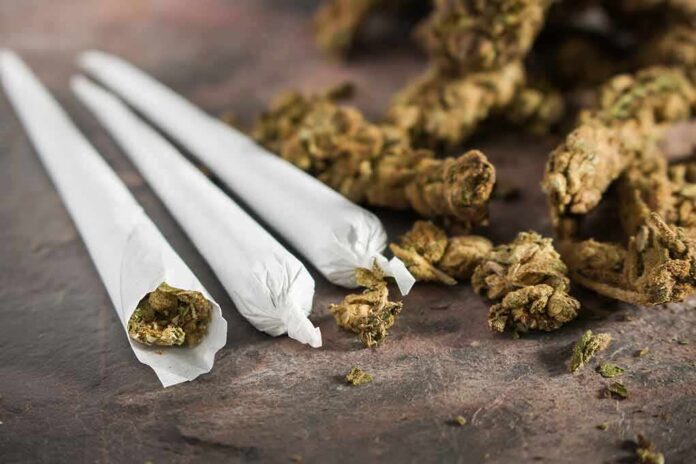
More Canadians now light up a joint every day than pour themselves a daily drink, according to a new national study that researchers are calling a “generational shift.”
Story Snapshot
- A new study finds 5.7% of Canadian adults use cannabis daily, compared with 5.2% who drink alcohol daily.
- Researchers estimate about 1.8 million people in Canada use cannabis every day or nearly every day.
- The gap is widest among younger adults, with men ages 25 to 34 showing the biggest split between pot and booze.
- Daily cigarette use, at 8.5%, still outpaces both cannabis and alcohol nationwide.
- The shift comes six years after Canada legalized recreational cannabis in 2018.
Survey Finds Cannabis Edges Past Alcohol
Researchers analyzed the 2023 to 2024 Canadian Community Health Survey, a large national poll of adults 18 and older. They found daily cannabis use at 5.7%, just ahead of daily alcohol use at 5.2%. That is a small gap in raw numbers, but it marks the first time daily cannabis use has topped daily drinking in Canada’s data. The study ran in the Canadian Medical Association Journal, Canada’s leading medical publication.
The survey covered nearly 100,000 people across the country, giving the findings strong statistical weight. Researchers calculate that roughly 1.8 million Canadians now use cannabis daily or almost daily. Lead researchers describe the trend as a “generational shift,” pointing to younger adults as the main drivers behind the change in habits.
Young Men Show the Starkest Divide
The biggest contrast showed up among men ages 25 to 34. In that group, 10.8% reported daily cannabis use, compared with just 2.9% who drank alcohol every day. That is nearly four times as many daily cannabis users as daily drinkers within that age bracket. Adults under 50 overall were more likely to use cannabis than alcohol on a daily basis, researchers found.
Daily cannabis use among adults under 35 is now roughly as common as daily cigarette smoking in that same age group. Cigarettes still lead nationwide, with 8.5% of all adults smoking daily. But that gap narrows sharply once researchers isolate the youngest adults, suggesting smoking habits are converging across substances for a new generation.
Legalization’s Mixed Six-Year Record
Canada legalized non-medical cannabis in October 2018, becoming one of the first major countries to do so. Since then, studies tracking the policy’s effects have found a mixed picture. Cannabis use rose modestly among adults after legalization, while alcohol use stayed roughly stable, according to separate research reviewed alongside the new study. Cannabis-related emergency visits and hospital admissions have also mostly increased or held steady over the same period.
Health Canada’s own guidelines warn that frequent or daily cannabis use is one of the strongest predictors of long-term health problems tied to the drug. That warning sits alongside the benefits often cited by legalization supporters, including fewer cannabis-related arrests and billions of dollars in government and industry revenue. Researchers caution the new daily-use numbers reflect frequency, not total consumption or overall health harm, across the two substances.
What the Numbers Do Not Settle
The study’s authors stop short of claiming cannabis has overtaken alcohol in every measure. Alcohol remains more widely consumed overall when counting occasional and social drinkers, not just daily users. The crossover applies specifically to daily or near-daily use, a narrower slice of behavior that researchers say still matters because frequent use carries the highest health risks tied to any substance, legal or not.
For many Canadians, especially parents and older adults who remember cannabis as an illegal drug just years ago, the finding lands as a sign of how fast norms have changed. Lawmakers who built Canada’s legal cannabis market in 2018 did so promising tighter regulation and safer access. This data gives both supporters and critics of that policy new numbers to argue over as the country marks its sixth year of legal weed.
🇨🇦 More Canadians now use cannabis daily than drink alcohol daily, a new CMAJ study finds.
5.7% of adults (~1.8 million people) report daily or near-daily cannabis use, vs 5.2% for alcohol. Daily cigarette use is still highest at 8.5%. Survey of nearly 100,000 people, 2023–24.…
— Four Twenty Maps (@420mapsco) November 23, 2026
The researchers say the trend deserves close attention from public health officials going forward. “We have to take daily cannabis use pretty seriously,” the study’s lead author told reporters following publication. With younger generations driving the shift, the long-term health and social effects of this crossover remain an open question for Canadian health systems to track in the years ahead.
Sources:
youtube.com, cmaj.ca, cbc.ca, news.mcmaster.ca, sciencesources.eurekalert.org, ca.news.yahoo.com, canada.ca, globalnews.ca