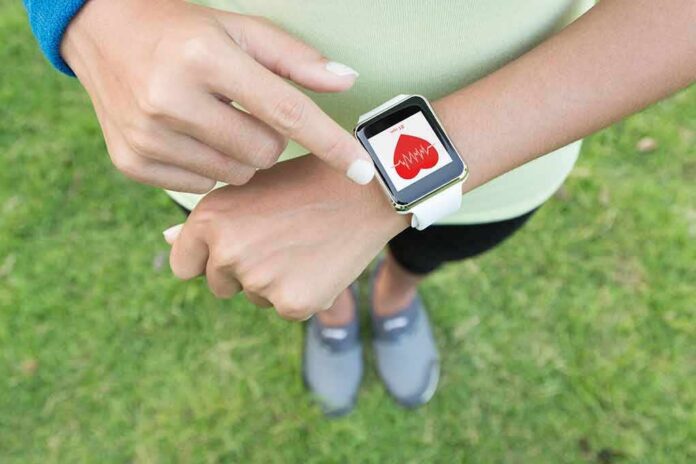
One thousand women across India strapped on wearable sensors this year to answer a question no government agency had bothered to measure: what does deadly heat actually do to a street vendor, a tailor, or a home-based garment worker who has no boss, no sick leave, and no air conditioning?
Story Snapshot
- A Harvard-partnered study called Community Heat Adaptation and Treatment Strategies is tracking 1,000 women in India’s informal labor force for 13 months using wearables, microsensors, lab tests, and surveys.
- The Self Employed Women’s Association, a group representing 1.8 million informal women workers, is co-leading the research effort.
- Earlier SEWA surveys found nearly 80 percent of members reported heat-related income loss, health problems, or both.
- Globally, informal women workers lose an estimated $57 billion a year in earnings to extreme heat, a figure projected to triple or quintuple by 2050.
A Study Built Around Real Lives, Not Just Lab Numbers
The Community Heat Adaptation and Treatment Strategies project, known as CommHATS, recruited 1,000 women working informally in India and outfitted them with wearable devices and microsensors for over a year. Researchers are pairing that physical data with wage records, health checkups, and personal surveys. The goal is simple: turn invisible suffering into hard numbers that policymakers cannot ignore.
Harvard researchers are working directly with the Self Employed Women’s Association, known as SEWA, and India’s Centre for Advanced Research in Building Science and Energy at CEPT University. This is not a survey conducted from a distance. It follows women through their actual workdays, indoors and outdoors, across South Asia’s varied climates.
Why Informal Workers Carry the Heaviest Burden
SEWA represents 1.8 million women working without formal contracts, benefits, or legal protections. An internal SEWA survey found nearly 80 percent of 600 members reported losing income to heat, suffering health problems, or both. A separate Delhi-focused study found 74 percent saw less demand for their work, 84 percent cut their hours, and 88 percent said heat directly hurt their output.
These women lack the basic protections most American workers take for granted. There is no employer-mandated water break, no air-conditioned break room, no paid sick day when heatstroke hits. When the temperature spikes, their paycheck shrinks the same day. One study found heat-related illness struck 83 percent of informal workers compared to a much smaller share of formal employees.
The Economic Toll Is Measured in Billions
Researchers estimate informal women workers worldwide lose $57 billion in earnings every year to extreme heat, representing 4 to 11 percent of their wages. Without new protections, that toll could triple or quintuple by 2050 as global temperatures keep climbing. That is not an abstract projection. It is millions of families losing grocery money because the thermometer crossed a dangerous line.
A cross-sectional health study found that in districts with the highest heat risk, 63 percent of informal-sector women reported heat-related symptoms, compared with 32 percent in formal jobs. The gap is not small. It reflects a structural failure to extend basic labor protections to people who make up the backbone of India’s economy but remain outside its legal safety net.
Insurance and Policy Gaps Still Leave Millions Exposed
SEWA has already tested a parametric heat insurance program, paying out benefits automatically when temperatures cross a set threshold. An early 2023 pilot covering 21,000 women triggered no payouts because the bar was set too high. A later version covering more than 225,000 women across four states required two consecutive days of extreme heat before benefits kicked in. Even a well-intentioned safety net can fail if the trigger point ignores how real bodies suffer.
India’s labor codes still largely exclude small firms and informal workers from climate-related workplace protections. That gap matters because 92 percent of Indian women in paid employment work informally, meaning most female workers fall outside whatever rules do exist. This is a policy blind spot, not a mystery. The data now exists to fix it, if lawmakers choose to act on it.
What makes the CommHATS study notable is its scale and its method. It does not rely on secondhand estimates. It puts sensors on real women doing real jobs in real heat, then tracks the wage and health consequences over more than a year. That kind of ground-level evidence is exactly what turns a vague climate concern into a policy argument grounded in fact.
Sources:
time.com, wiego.org, sddirect.org.uk, cgap.org, heathealth.info, ilo.org, mittalsouthasiainstitute.harvard.edu