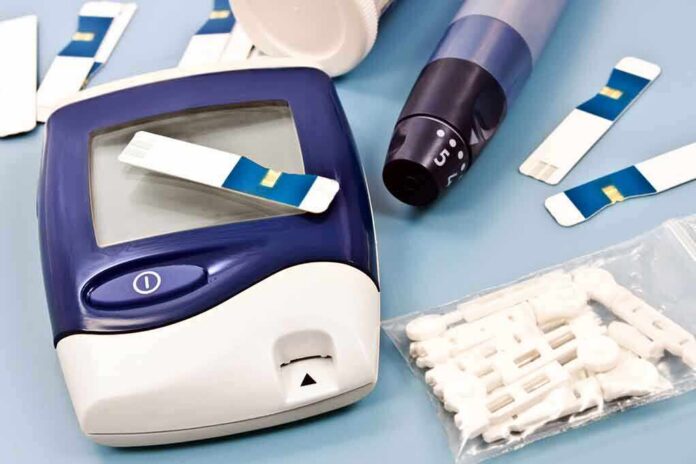
A coin-sized chip built at the University of Cambridge could one day read your blood sugar, your hydration, even your blood alcohol level, all without a single needle prick.
Quick Take
- Cambridge researchers and spin-off company GlitterinTech built a centimeter-scale spectrometer chip estimated to cost about $10.
- In reported lab tests, the chip classified materials like plastics, coffee, flour, and medicines with a 100% success rate.
- One participant wore the device for extended non-invasive glucose tracking, an early proof of concept rather than a finished product.
- Clinical validation, manufacturing costs at scale, and regulatory review still stand between this chip and your wrist.
A Lab Instrument Shrunk Down To Pocket Change
Spectrometers have lived in research labs and hospitals for decades, reading how light bounces off a substance to figure out what it’s made of. Full-size versions cost thousands of dollars and take up table space. The Cambridge team, working with its spinout company GlitterinTech, shrank that same core idea onto a chip small enough to wear, with an estimated price tag near $10.
The chip works by shining near-infrared light, in the 1200 to 1700 nanometer range, through or onto a sample, then reading the pattern that bounces back. Researchers say it returns a result in under one second, fast enough to be useful outside a lab setting. That speed matters for a wearable, because nobody wants a health gadget that takes a coffee break to tell you your blood sugar.
What The Chip Actually Proved In Testing
In reported trials, the device sorted plastics, pharmaceuticals, coffee, flour, and tea with a 100% classification success rate. It also measured concentrations in liquid solutions with roughly 0.01% accuracy, and one account says it beat a commercial benchtop spectrometer in side-by-side testing. Those are strong early numbers for a device this small and this cheap, and they explain why the announcement is turning heads in engineering circles.
The researchers pushed further, testing the chip against skin moisture, blood alcohol, lactate, and glucose under conditions built to mimic the human body. Then came the headline-grabbing part: one participant wore the chip for an extended stretch while it tracked glucose levels without drawing blood. For anyone who manages diabetes with daily finger pricks, that single data point points toward a future worth watching.
Why One Participant Is A Start, Not A Finish Line
A one-person glucose demonstration shows the concept can work. It doesn’t show the chip works the same way on different skin tones, body types, or health conditions. Reporting on the project makes clear that further clinical validation is required before this becomes a tool doctors or diabetics can rely on for routine blood-sugar monitoring. That’s a normal, expected step for any new medical sensing technology, not a knock against the science.
Non-invasive glucose monitoring has a long, bumpy history. Past optical approaches have shown real promise in small trials, with some reporting correlation scores in the 0.85 to 0.95 range against standard glucometers, but scientists have also warned for years that commercial excitement sometimes runs ahead of the underlying science. Reviewers have cautioned that the physics behind reading glucose through skin “is not yet well established” even after decades of research. Cambridge’s chip now joins that long line of promising attempts waiting on bigger studies to prove it holds up.
The Road From Lab Bench To Store Shelf
The $10 figure describes the chip itself, not a finished wearable product. It likely doesn’t include the battery, housing, software, calibration, or the testing needed to prove a device is safe to wear against skin for weeks at a time. Building something you’d actually strap to your wrist and trust with your health data means clearing cost hurdles, durability testing, and a regulatory review process that exists precisely to keep unproven gadgets out of your medicine cabinet.
Still, the underlying engineering achievement stands on its own. Cambridge and GlitterinTech built a lab-grade light sensor at a size and price that opens doors other technologies couldn’t reach. Skepticism about overhyped health gadgets is healthy, but so is giving credit where real engineering progress has been made. This chip earned its headlines; now it needs the years of testing to earn a spot on store shelves.
A $10 SENSOR COULD BRING LABORATORY TECHNOLOGY TO YOUR WRIST
Researchers at the University of Cambridge developed a tiny optical sensor costing approximately $10 that can perform measurements typically requiring large laboratory equipment.
Called a convolutional spectrometer,… pic.twitter.com/LVR0DCAFl7
— Joakims World 369 (@JoakimsWorld369) October 24, 2026
Expect more data, more participants, and eventually a peer-reviewed paper laying out exactly how this chip performs outside a controlled lab. Until then, the $10 chip remains one of the more exciting early steps toward affordable, needle-free health monitoring, built on real results, with real work still ahead.
Sources:
sciencedaily.com, ua.news, ukr.net, eng.cam.ac.uk, aroundprague.cz, medicaldialogues.in