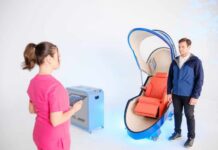
Dr. Nick Ramsey helped turn brain-computer interfaces from lab promise into a real communication tool for people with late-stage ALS.
Quick Take
- A fully implanted brain-computer interface let a woman with late-stage ALS control a typing program by trying to move her right hand.
- Ramsey said the result showed brain signals can support communication in a severely paralyzed patient with a simple implantable device.
- The first system worked, but it was slow. The patient typed at about two letters per minute.
- Newer systems have pushed speed and accuracy higher, including speech restoration studies that report near-fluent performance.
How Ramsey’s Utrecht Project Changed the Debate
Ramsey’s Utrecht Neuroprosthesis project focused on one hard question: can a person with almost no movement still communicate on their own? The answer from the 2016 case study was yes. A woman in a locked-in state used a fully implanted device at home to operate computer typing software. Ramsey called it a major step because the system stayed inside the body and did not need outside specialists to function.
That first success mattered because it moved the field past theory. The implant used electrodes over the motor cortex and a transmitter under the skin. The patient tried to move her hand, and the system turned that effort into computer control. The result was not fast, but it was independent. She could choose letters herself, and the device sometimes replaced her eye-tracking system instead of just backing it up.
Why the Early Breakthrough Still Felt Limited
The early implant proved the concept, but it also exposed the size of the challenge. Two letters per minute is communication, but only barely compared with ordinary typing. That speed helped explain why Ramsey kept talking about later versions and more advanced implants. The science had crossed a line, but the practical problem was still wide open: how to make the system faster, easier, and useful for more than a few carefully chosen tasks.
That gap between proof and usefulness is where the story gets interesting. Later studies moved from cursor control to speech decoding, and the gains were dramatic. One 2024 report described speech restored with up to 97.5 percent accuracy, while another reported 62 words per minute for an ALS participant. Those numbers show how quickly the field advanced, but they also set a new standard that early implants could never meet.
What the Newer Studies Add
Recent work shows that communication BCIs now do more than produce a single striking case. One study reported mean selection accuracy of 93.9 percent and typing correctness of 97.2 percent over a year, with users able to email, text, and browse the internet. Another found stable decoding for three months without recalibration in a person with ALS. A separate long-term study showed stable communication for up to 138 days with an unchanged decoder in two people with severe paralysis.
Those results matter because they answer the question critics always ask first: does the device keep working? Stability is the real test. ALS is a moving target, and signal quality can change as the disease progresses. Researchers now study adaptive calibration to keep the system useful over time. That is the next frontier, along with larger vocabularies, lower error rates, and home use that does not depend on a research team standing nearby.
What the Public Often Misses
The biggest misunderstanding is simple. A brain-computer interface does not read thoughts like a mind reader. It learns patterns tied to trained movement or speech intent. That means the system depends on calibration, patient effort, and careful design. It also means headlines can run ahead of reality. A “breakthrough” can be real and still slow, invasive, and expensive. Ramsey’s work shows both sides at once: the promise is genuine, and the limits are still there.
For readers over 40 who have watched enough medical hype to be skeptical, that honesty is the story’s strength. The field no longer asks whether communication is possible. It asks who can use it, how reliably, and at what speed. Ramsey’s early implant answered the first question. Newer systems are racing to answer the rest. The pace is still uneven, but the direction is unmistakable. The locked-in patient is no longer a dead end.
Sources:
youtube.com, nature.com, utrecht-bci.nl, als.ca, nytimes.com, medpagetoday.com, pubmed.ncbi.nlm.nih.gov, alsnewstoday.com