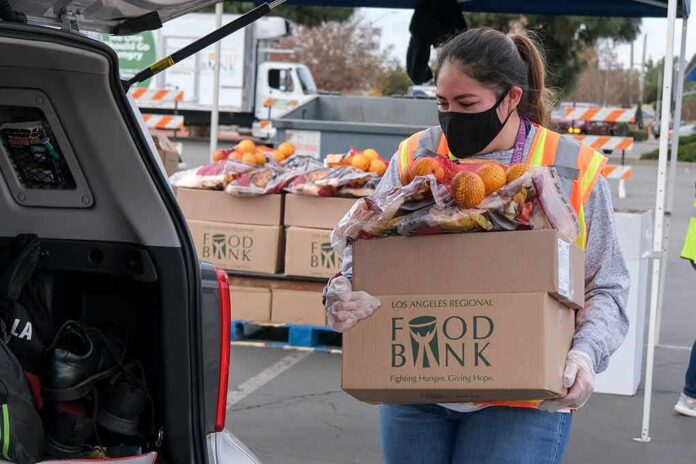
Food banks across the country are running short on food at the exact moment more families are showing up for help.
Quick Take
- A federal review found over 81% of food banks lacked enough supplies during the pandemic’s peak, a strain many say has not fully eased.
- Demand for emergency food has stayed elevated even as some government aid programs have shrunk or stalled.
- Federal nutrition spending rose only 1.5% in fiscal year 2025, barely keeping pace with need.
- Feeding America says halted government funding and rising costs are squeezing food banks’ ability to serve families right now.
A Safety Net Built for Emergencies, Now Stretched Thin
Food banks were never meant to be a permanent fix. The federal government created The Emergency Food Assistance Program back in 1983 to handle short-term crises like recessions. Today, that same patchwork system of donated food, government commodities, and volunteer labor is being asked to carry a much heavier load, year after year, with no end in sight.
Government food now makes up a bigger share of what food banks hand out. A U.S. Department of Agriculture review found that food distributed through Feeding America’s network rose between 2017 and 2021, with government-supplied food jumping from 18% to 28% of total distribution. That shift shows food banks leaning harder on federal help just as that help becomes less predictable.
Demand Has Not Gone Back Down
The need never really faded after the pandemic. A U.S. Department of Agriculture review found that 81.4% of food banks reported not having enough supplies to meet demand in July 2020, during the worst of the crisis. Years later, food insecurity still touched 13.7% of U.S. households at some point in 2024, meaning tens of millions of people struggled to get enough to eat.
Feeding America, the nation’s largest hunger-relief network, says that pattern has not reversed. The group’s spring 2025 impact report points to rising costs, supply chain problems, and policy changes as forces piling pressure onto food banks already stretched thin. The report specifically names halted government funding as a direct hit to food banks’ ability to get nourishing food to people who need it.
Federal Dollars Barely Keep Pace
Washington’s spending on food and nutrition aid grew only slightly last year. Total federal spending on the U.S. Department of Agriculture’s food and nutrition programs rose just 1.5%, from $145.6 billion in fiscal year 2024 to $147.9 billion in fiscal year 2025. For a safety net facing steady or rising need, that modest bump does little to close the gap between what families require and what the government provides.
Most U.S. households still had enough to eat throughout 2024. The U.S. Department of Agriculture found 86.3% of households were food secure all year, leaving about one in seven households facing some level of food insecurity at some point. That gap is exactly where food banks are supposed to step in, and exactly where they say they are struggling most.
SNAP Cuts Pile On the Pressure
Feeding America reports that demand at its food banks remains elevated even as participation in the Supplemental Nutrition Assistance Program, the federal food stamp program, has declined. The organization warns that changes to nutrition assistance could make getting food less predictable for people already facing hunger, forcing more of them to turn to food banks instead.
This mirrors a pattern seen during the pandemic, when researchers found the charitable food system itself became overburdened as government aid programs faced disruptions, leaving food banks to absorb demand that outpaced their resources. Whether the pressure comes from a pandemic, an economic downturn, or a funding freeze, the result for food banks tends to look the same: more people in line, less on the shelves.
Families on both sides of the political divide are showing up at food pantries, a sign hunger does not sort itself by party. What’s clear from the data is a structural mismatch: emergency food aid was designed as a short-term bridge, but it has become something families rely on for years at a time, while federal funding struggles to stretch far enough to meet that reality.