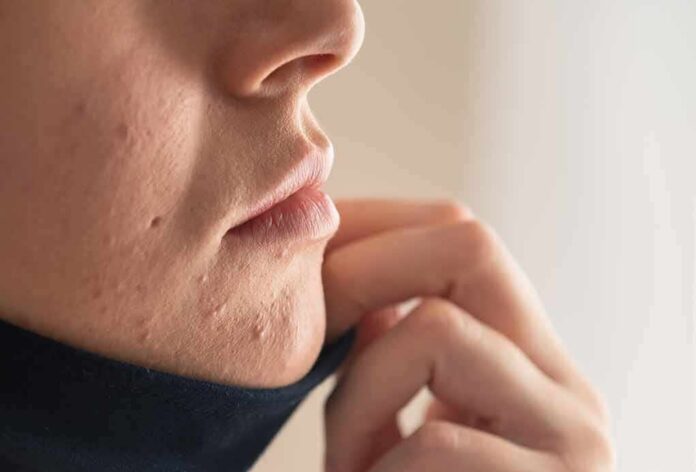
Stubborn breakouts and red, flaky patches that refuse every cream you try may trace back to something nowhere near your face: your gut.
Quick Take
- Dermatologists and researchers describe a “gut-skin axis” linking digestive health to eczema, acne, and rosacea.
- Studies show patients with rosacea and eczema often have different gut bacteria than people with clear skin.
- Small intestinal bacterial overgrowth, or SIBO, shows a strong statistical link to rosacea in multiple studies.
- Doctors caution the science shows a connection, not proof that gut problems cause skin disease in most patients.
What Doctors Mean By The Gut-Skin Axis
Dr. Myra Reed and other physicians point to a two-way street between your intestines and your skin. Gut bacteria help control inflammation, immune signals, and even hormone levels throughout the body. When that bacterial balance tips out of order, doctors say the fallout can show up as chronic rashes, breakouts, or facial redness that never fully clears, no matter what cream you try.
This idea isn’t fringe theory. A peer-reviewed review on rosacea described the gut-skin relationship as a real, bidirectional network involving gut and skin bacteria, immune cells, and inflammatory chemicals that travel through the bloodstream. Researchers have documented this pattern across several inflammatory skin conditions, not just one.
The Evidence Linking Gut Bacteria To Rosacea
Rosacea has the strongest research trail so far. A Danish study tracked nearly 50,000 rosacea patients against more than four million people without the condition and found clear links to gut disorders. Separate research found rosacea patients were far more likely to test positive for small intestinal bacterial overgrowth than people with clear skin.
That overgrowth link isn’t just an observation sitting in a lab notebook. A meta-analysis combining six studies and more than 800 patients found that treating SIBO with the antibiotic rifaximin led to rosacea improvement or remission in nearly 58 percent of patients, climbing as high as 86 percent in some trials. That’s a real treatment outcome, not just a correlation on paper.
Eczema And Acne Show Similar Bacterial Patterns
Eczema and acne tell a related story. A 2024 study used a genetic research method called Mendelian randomization and found a causal relationship between gut microbiota and four inflammatory skin diseases: eczema, acne, psoriasis, and rosacea. Other researchers have tied acne to gut microbial imbalances that may drive inflammation and excess oil production through specific bacterial byproducts.
None of this means a messed-up gut is the only reason your skin won’t behave. Researchers studying the broader gut-skin field consistently note that most human evidence remains observational, meaning it shows a pattern without proving the gut caused the skin problem in every patient. That distinction matters before anyone overhauls their diet chasing a cure.
Why This Framework Still Matters For Patients
Scientists reviewing the field call the gut-skin axis “biologically supported but not yet fully validated,” a fair way to sum up where things stand. That’s not a dismissal. It’s an honest acknowledgment that a real mechanism exists, even while the full picture of who it affects and how severely remains unfinished.
For patients who’ve cycled through every prescription cream and steroid ointment without lasting relief, that unfinished picture still offers something worth pursuing: a reason to ask a doctor about digestive health, not just skin-deep fixes. Probiotic strains and dietary changes have shown real anti-inflammatory benefits in some trials for psoriasis, eczema, and rosacea. For a condition that mainstream medicine has often treated as purely topical, that’s a meaningful shift in direction.
The takeaway isn’t that every rash starts in the stomach. It’s that skin conditions resistant to standard treatment deserve a second look at what’s happening further down the digestive tract, backed by a growing body of published research rather than internet trend chasing.
Sources:
youtube.com, link.springer.com, pmc.ncbi.nlm.nih.gov, onlinelibrary.wiley.com, pubmed.ncbi.nlm.nih.gov