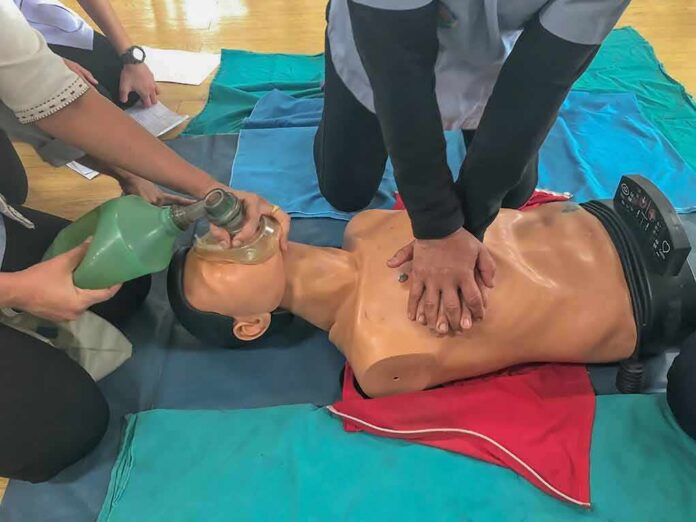
A kid who learns to push hard and fast on a chest can double someone’s chance of walking out of the hospital alive.
Quick Take
- Bystander CPR nearly doubles survival after cardiac arrest, yet fewer than half of adult victims get it before paramedics arrive.
- Schools reach almost every child, making them the most efficient place to teach a skill that saves lives.
- States with CPR graduation requirements already show higher rates of bystander CPR and defibrillator use.
- Money, time, and equipment shortages, not doubts about CPR’s value, are the real reason many schools skip real training.
The Survival Gap Bystander Training Could Close
When someone’s heart stops outside a hospital, the clock turns deadly fast. The American Heart Association reports that witnessed arrests where a bystander started CPR had a 13 percent survival rate to hospital discharge, compared with 7.6 percent for unwitnessed cases. Yet only 41.7 percent of adult victims receive that help before paramedics show up. That gap between what works and what actually happens is the whole argument for teaching CPR in school.
Schools are not just classrooms. They are the one place almost every American child shows up, year after year. Attendance runs 97.4 percent for kids ages 5 to 14 and 76.5 percent for teens 15 to 19. No other institution touches that many future bystanders. If the goal is building a nation of people who know what to do when a stranger collapses, the school hallway beats any public health campaign ever designed.
States that already require high school CPR training report higher rates of bystander CPR and defibrillator use in real emergencies. Denmark took this further, mixing mandatory elementary school instruction with driver’s-license training and free self-instruction kits mailed to homes. Bystander CPR rates jumped from 21 percent in 2001 to nearly 45 percent in 2010, and survival more than tripled over that stretch. That is not a theory. That is a country that decided to treat CPR like a basic life skill, not a medical specialty, and watched the numbers move.
Why So Many Schools Still Skip It
If the evidence is this strong, why isn’t CPR as standard as a fire drill? The honest answer is money and logistics, not disagreement about whether it works. A Rhode Island study found time, budget concerns, and lack of practice equipment were the top barriers schools cited for not training every student. Iowa made CPR a graduation requirement back in 2011 but never sent districts a dime to pay for it. A law without a budget is a wish, not a plan.
New York offers a counterpoint worth noting. State education officials estimated a typical 3,000-student district could launch CPR training for about $3,054 upfront, with yearly costs near $1,392 after that. Statewide, the full price tag came to roughly $2.7 million to start and $1.2 million a year to maintain. That is a rounding error next to most state education budgets, which makes the funding excuse harder to defend when lawmakers choose not to write the check.
Colorado tried a softer approach in 2023, encouraging CPR training without requiring it or funding it. Critics, including the Colorado Association of School Executives, called it a feel-good gesture that left local districts to decide whether the skill was worth their time and money. That tension between state recommendation and local control shows up in nearly every state that has touched this issue, and it explains why coverage looks so different from one zip code to the next.
What Good Implementation Actually Requires
The American Heart Association does not just recommend a one-day classroom lesson. It calls for full cardiac emergency response plans: a trained response team, properly placed and maintained defibrillators, campus-wide communication, annual drills, and coordination with local emergency medical services. A single freshman-year lecture on chest compressions is not the same thing, and treating it as equivalent risks giving parents and lawmakers false confidence in programs that lack the follow-through to matter.
Reviews of existing school mandates back up that concern. Researchers have found that even where CPR training is legally required, it does not always get fully implemented, with some programs skipping hands-on practice or defibrillator instruction entirely because of staffing and cost pressures. Lower-income school districts face the steepest climb, since defibrillator funding is already thinnest in those zip codes. A mandate on paper means little if the manikins, the trained instructors, and the equipment never show up.
None of this undercuts the core case. The science on bystander CPR is settled, and schools remain the most efficient delivery system America has for teaching it. The real debate is not whether to teach kids this skill. It’s whether state legislatures will pair every mandate with the funding, equipment, and follow-up drills that turn a graduation requirement into a kid who actually knows what to do the day it counts.
Fixing that will take more than good intentions from statehouses. It will take the same discipline schools already apply to fire drills: regular practice, maintained equipment, and accountability for whether the training sticks. Parents pushing their local school boards for real answers on funding and follow-through may do more for this cause than any new law.
Sources:
time.com, heart.org, sca-aware.org, cpr.heart.org, legis.la.gov, ahajournals.org