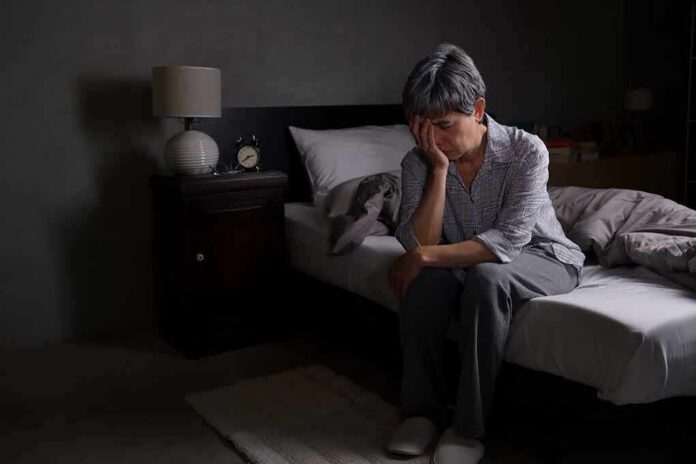
Feeling older than your actual age might be quietly stealing your sleep, and new research says the reverse may be true too.
Quick Take
- A study of 3,177 adults found people who feel older than their real age report more insomnia and worse sleep quality.
- The link showed up across several sleep measures, including sleep regularity and daytime impairment, not just one test.
- A separate Korean study of 2,349 people found the same pattern, with poor sleep nearly doubling among those who feel older.
- Other research suggests the arrow may point both ways: bad sleep can also make people feel older.
A Large New Study Ties Feeling Old To Feeling Exhausted
Researchers surveyed 3,177 adults online, with an average age of 42.8 years, for a study set to appear at the SLEEP 2026 annual meeting. They asked people how old they felt compared to their real age. Then they measured insomnia symptoms, sleep-related impairment, overall sleep health, and sleep regularity using several standard questionnaires.
People who felt older than their actual age reported more insomnia symptoms, more sleep-related impairment, lower sleep health, and less regular sleep schedules. Every one of those links was statistically meaningful. The researchers behind the work described feeling “older than you are” as connected to worse outcomes across the board, not just one narrow symptom.
A Separate Population Study Found The Same Pattern Years Earlier
This is not an isolated finding. The Korean Sleep and Headache Study interviewed 2,349 people face-to-face in 2018 and found a clear step pattern. Those who felt older than their age scored worse on a standard sleep quality scale than those who felt their actual age, who in turn scored worse than those who felt younger.
The numbers were striking. Nearly 29 percent of people who felt older reported poor sleep, compared to about 18 percent of those who felt their age and just 13.5 percent of those who felt younger than they really are. That is more than a two-fold gap between the oldest-feeling and youngest-feeling groups.
Older Research Suggests This Pattern Builds Over Time
A 2017 study followed middle-aged and older adults across multiple samples and found that feeling older at the start was tied to worsening sleep problems later on. People who felt older than their age were more likely to develop major sleeping difficulties down the road, not just report them at a single moment in time.
That same study found depression, anxiety, and chronic health conditions played a role in explaining part of the connection. In plain terms, feeling older does not act alone. It travels alongside mental and physical health struggles that can independently wreck a good night’s sleep.
The Relationship May Run In Both Directions
A 2024 study published in Proceedings of the Royal Society B flipped the question around. Researchers tracked 429 people and found that every extra night of insufficient sleep over a month was linked to feeling roughly a quarter-year older. They also ran an experiment restricting sleep on purpose and watched subjective age shift in response.
That means the honest answer is not a one-way street. Feeling older may worsen sleep, and losing sleep may make you feel older. Researchers studying this topic increasingly describe it as a feedback loop rather than a single cause and effect.
Why This Matters For Anyone Over 40
The current evidence comes from surveys and questionnaires, not lab-measured brain waves or wearable sleep trackers. That does not erase the pattern, but it does mean the findings describe what people report, not a confirmed biological mechanism. Full study details from the 2026 meeting presentation are not yet published in complete form.
Still, the consistency across three separate studies, spanning different countries and years, gives this pattern real weight. If you have caught yourself saying “I feel older than my years” and also tossing and turning at night, you are not imagining a connection. Researchers are now racing to figure out which comes first, and how to break the cycle.
Sources:
mindbodygreen.com, academic.oup.com, pubmed.ncbi.nlm.nih.gov, sleepmeeting.org, royalsocietypublishing.org, snu.elsevierpure.com